
In my most recent blog post about a family with eight children surviving to adulthood, I almost wrote that there were nine children surviving. I saw nine children in the family who lived long enough to marry. But one of those was only twelve when she married, and she died at age thirteen! So I decided that (by my modern-day standards) thirteen didn’t count as an adult, and so I amended my post accordingly.
Before we get into Margueritte’s story, a bit of background. When I was growing up I heard a lot talk about how back in the old days most everyone got married very young – early teens or even younger sometimes. Some of this came from my school teachers, who should have known better.
So when I took a class in college on European Social History, I was quite surprised to learn that first marriages among the poor (that was almost everyone) usually didn’t happen until their mid to late 20s or later! Only in the more modern era (1800s and later) in Europe as conditions improved, did marriage ages start to move younger. It kind of blew my mind to have my old ideas overturned like that, and a little part of me had a hard time letting go of the old ideas . . . .
Fast forward a few more years until I got seriously into genealogy. I’ve added several thousand French people to my family tree since then, and to do so I have read through even more pages in the record books. That experience has confirmed that what I learned in college was true. Most people didn’t get married young! The grooms are often in their late 20s and the bride in her mid 20s, and it’s not unusal to find them in their 30s. A teenage bride is rare, and a teenaged groom is even rarer. Caveat: I’ve mainly research in France in the 1600s through mid 1800s. Other parts of Europe may be different. Certainly other parts of the world ARE different. In the U.S., marriage ages moved younger earlier due to more available land and better economic opportunity. And sadly, there are still child brides in parts of the world today.
Where did this “young marriage” ideas come from? The nobility sometimes did marry off their children very young to form alliances. The marriages were sometimes carried out by proxy and the children would often remain at home until they were older. The rich had the luxury of marrying off their children whenever they wanted to. But this was the exception. The vast majority of the peasants could not afford to marry young.
Now, on to the big exception!
Margueritte Leveillé was baptized on 1 March 1677 in Sancerre, Cher, France. She is the oldest child of Estienne Leveillé and Marie Anne Blanchon.1 Catholic baptisms in this time and place were almost always performed on the day of the birth or the next day.
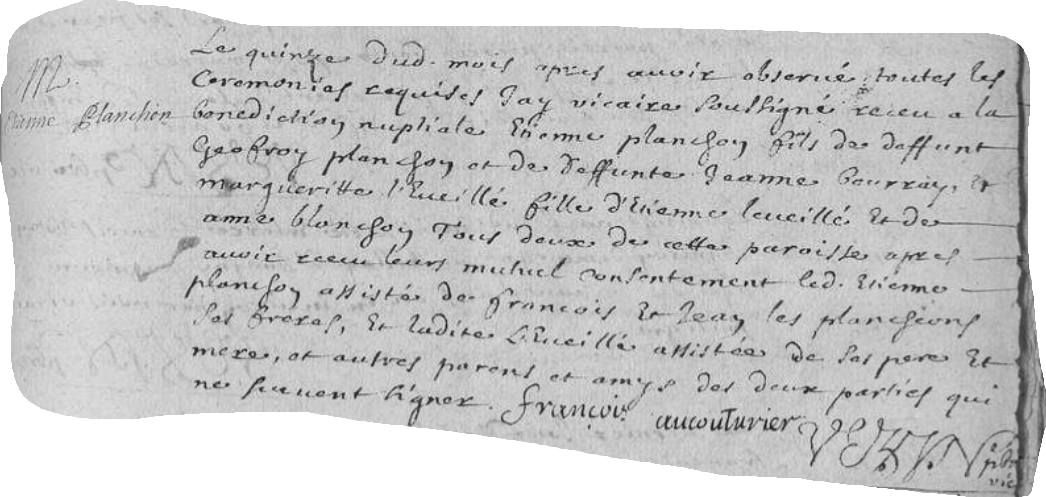
Margueritte married Etienne Planchon on 15 October 1689. She was only twelve years old. He had just turned twenty. Her parents are named, so this definitely the same child who was born in 1677, and not someone else with the same name.2

Only seven months later, on 1 June 1690, Marguerite died, and was buried the next day. She was identified as the wife of Estienne Planchon. Her age is given as about 14 years, but the math shows that she was still 13.3
So why was she married so young? Notorial records might give a clue, but they are not available online for the Cher department before 1791. Was she pregnant, and “had” to get married? Her early death points to childbirth complications. But there is no record of any birth of a child to her between her mariage and her death.
The rest of her siblings did not marry so young, although three were teenagers. Her sisters married at ages 24, 19, 19, 22, and 19. Her brothers married at 28, 29, and 23.
Perhaps she really did want to marry. She wouldn’t be the only 12 year old to look at an older teenager and want to be with him. Or she was tired of the being the oldest daughter and child with all of the responsibilities that entailed. She had six younger siblings at home when she married – that’s a lot of work.
In the end, the reasons “why” are all speculation. All we can do is hope that her short life was as happy as possible.
- Archives Départmentales de Cher, Sancerre, 3E 1029, 1675-1692, 1 mars 1677, Marguerite Leveillé, image 21/327. ↩︎
- Ibid., 15 octobre 1689, Planchon & Leveillé, im. 270. ↩︎
- Ibid., 2 juin 1690, Marguerite Leveillé, im. 283. ↩︎
Discover more from Harman Genealogy Blog
Subscribe to get the latest posts sent to your email.